
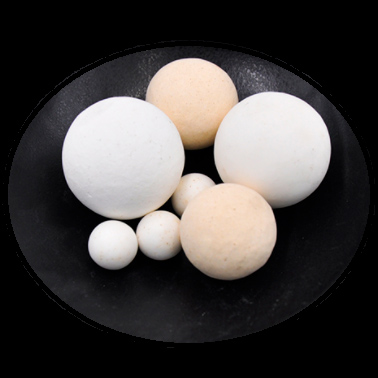
Inert ceramic balls
Pack: polypropylene bags of 25 kg net
Inert ceramic balls are loaded to the industrial reactors:
- for the improvement of dynamical properties of the gases or liquid media;
- as the pressing material;
- as the protective layer for the catalyst.
The ceramic balls manufactured with material, providing the balls stability under hard-operation conditions, such as high pressure drops, high temperatures, strong acids or alkalies. The mail applications of the inert ceramic balls: sulphur removal form the gas streams, hydrocracking, hydrogenation, reforming. The sizes and physical properties depend on the operating conditions. The widely used grades of the ceramic balls and their parameters:
Physical and Chemical Characteristics
|
Items
|
Unit |
Specification |
|
SiO2 |
% |
30.0±4.0 |
|
Al2O3 |
% |
65.0±4.0 |
|
Total SiO2+ Al2O3 |
% |
≥95.0 |
|
Fe content (as Fe2O3) |
% |
≤1.0 |
|
MgO+TiO2 |
% |
≤4.0 |
|
K2O+Na2O+ CaO |
% |
≤0.5 |
|
Leachable Fe content |
% |
Less than 0.1 |
|
Volume pore |
% |
40 |
|
Water absorbtion |
Mass % |
≤0.5 |
|
Hardness (Mohs) |
|
≥7 |
|
Particle’s density |
g/s |
2.3-2.4 |
|
Bulk density |
kg/m3 |
1360-1450 |
|
Highest operating temperature |
°C |
1000 |
|
Acid resistance |
% |
99.6 |
|
Alkaly resistance |
% |
85 |
Crush strengh
The crush strength depend on the diameter of the balls.
|
Diameter, mm(inch) |
Unit |
Value of the crush strength |
|
3 mm (1/8”) |
lbs/kg |
>77 (35) |
|
6 mm (1/4”) |
lbs/kg |
>144 (70) |
|
10 mm (3/8”) |
lbs/kg |
>330 (150) |
|
13 mm (1/2”) |
lbs/kg |
>600 (273) |
|
19 mm(3/4”) |
lbs/kg |
>1320(600) |
|
25 mm(1”) |
lbs/kg |
>2200 (1000) |
|
38 mm(1-1/2”) |
lbs/kg |
>2600(1182) |